

 21-10-2026
 Share
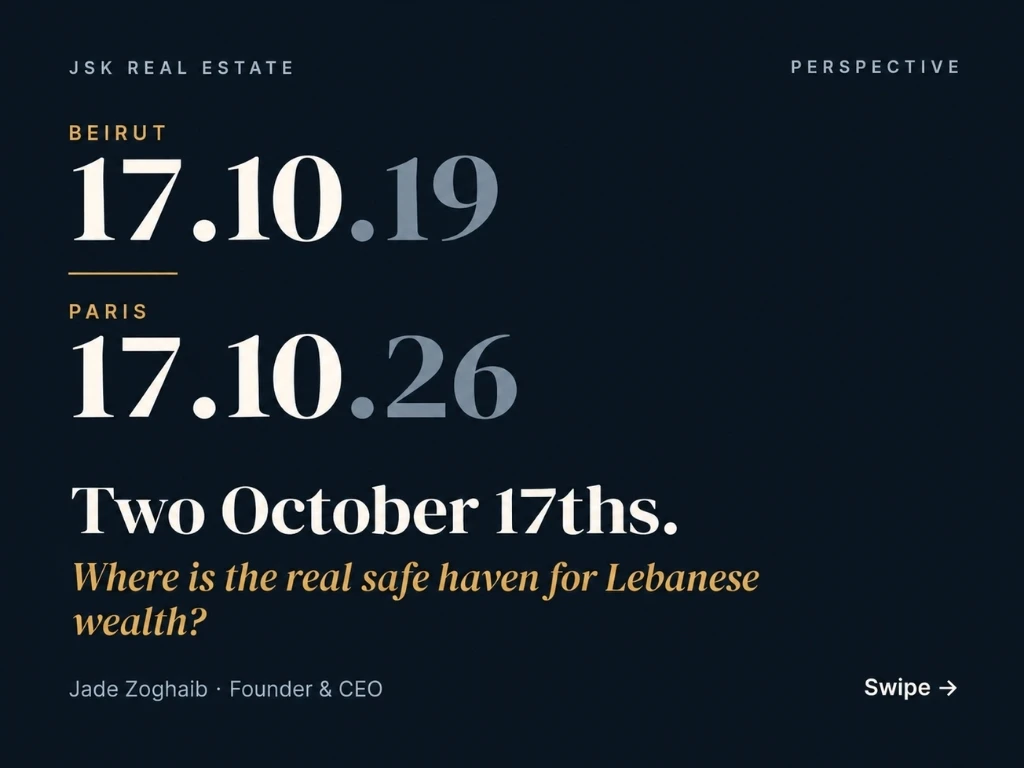
On October 17, 2019, the Lebanese took to the streets. Within months, their savings were frozen.
On October 17, 2026, to the day, hundreds of thousands marched across France.
Europe is not Lebanon. But Lebanon taught us a distinction many still confuse: a deposit that is safe is not necessarily wealth that is preserved.
After 2019, moving our money abroad was the right decision. Seven years later, should it still be the whole answer?
In my latest article, I make the case for diversification, including tangible assets in Lebanon, and I name the risks honestly. I run a Lebanese real estate company, so weigh my conclusion accordingly.
In 2019, we learned to protect our money from Lebanon.
In 2026, perhaps it is time to protect part of our wealth through Lebanon.
TWO OCTOBER 17THS
On October 17, 2019, a proposed tax on WhatsApp calls brought the Lebanese into the streets. The tax was merely the trigger. The real anger was rooted in debt, mismanagement, and years of declining trust. Seven years later, to the day, on October 17, 2026, France witnessed massive demonstrations: 550,000 protesters according to the Interior Ministry, 800,000 according to organizers. Frustrations over fuel prices, deteriorating school conditions, and the cost of living converged into broader discontent with public services, fuelled by declining trust in institutions. Different countries. Different crises. A familiar warning: economic frustration can expose deeper fractures.
Europe Is Not Lebanon. But It Is Not Immune. France's public debt has reached nearly €3.6 trillion, or 119% of GDP. Across Europe, governments face mounting debt, weak growth, and growing social frustration. This does not mean Europe faces a Lebanese-style collapse. European banks are better supervised, deposits benefit from stronger safeguards, and the European Central Bank is not Banque du Liban.
A deposit that is secure is not necessarily wealth that is preserved. Even money safely held in euros can lose purchasing power through inflation and taxation.
We Moved Our Money Abroad. Rightly So. Lebanese families who could transfer their savings turned to European and Swiss banks. It was a rational decision. But seven years later, should keeping our wealth abroad remain the only answer?
Why Real Estate? And Why Lebanon? At JSK, we witnessed families convert blocked bank deposits into property. One client purchased an apartment in Achrafieh using a banker's check. Her inaccessible savings became a registered property generating rental income in fresh dollars. She had little choice. Today's diaspora investor does. So why consider Beirut, Jbeil, or Batroun rather than Paris or Dubai?
Price and Opportunity JSK's market observations showed property price declines of approximately 3050% in fresh-dollar terms by 2022, depending on location and property type. Some prime properties have since recovered significantly, while other segments remain below precrisis valuations. The opportunity is not that everything in Lebanon is cheap. It lies in identifying quality assets at attractive prices, with rental potential and room for long-term appreciation if economic conditions improve.
Income and Personal Value A well-located property can generate rental income in fresh dollars while serving as a family home. For the diaspora, this means more than financial returns: a place for summer visits, retirement, and future generations to maintain their connection to Lebanon.
Ownership, Not a Claim Since 2019, Lebanon's property market has operated largely on cash, with mortgage financing almost nonexistent. This limits liquidity, but highlights an essential distinction: a properly registered property is an asset you directly own, not an unsecured claim against a bank.
The Risks Are Real. Let's Name Them. Real estate does not eliminate risk. It replaces banking exposure with political, security, market, and physical risks. The 2024 war reminded us that buildings can be destroyed. Properties may take months to sell, and legal due diligence, title verification, and construction quality remain essential. Lebanon also remains under increased monitoring by the Financial Action Task Force and on the EU's list of high-risk third countries for anti-money-laundering purposes, complicating certain financial transactions.
A bad investment does not become a good one simply because it is tangible. This is not an argument for bringing all our money back to Lebanon. It is an argument for diversification. Concentrating wealth in one country, currency, banking system, or asset class creates vulnerabilities of its own.
A Word of Transparency I run a Lebanese real estate company, and readers should weigh my conclusion accordingly. But my conviction also comes from seven years of watching families who held bank deposits and families who owned property experience the same crisis very differently. Real estate did not protect everyone. But direct ownership often provided options that blocked bank deposits could not.
Public confidence, economic stability, and financial security should never be taken for granted. No institution, no currency, and no country deserves blind trust. Including Lebanon. In 2019, we learned to protect our money from Lebanon. In 2026, perhaps it is time to protect part of our wealth through Lebanon.
Jade Zoghaib Founder & CEO · JSK Real Estate